Audi RS3 Sportback Review: The Five-Cylinder Shortcut to a Proper European Weekend

Daniel Müller
Luxury Mobility Editor & Automotive Content Specialist
The Audi RS3 Sportback is one of those cars that makes you reconsider what “enough” looks like in a city. It’s compact, easy to place on narrow streets, and then—when the road opens—hits you with that off-beat five-cylinder thrum and a 0–100 km/h claim that belongs in a much pricier postcode. The appeal for a Europe rental is obvious: airport pick-up to hotel without drama, then an evening blast to a mountain pass with the same key in your pocket. This review is based on manufacturer data and independent road tests—how it performs, how it fits real life, and where the compromises live.
A compact, brutally quick Sportback with a charismatic engine and clever AWD hardware. It feels special at sane speeds, but it’s not a “set-and-forget” comfort car, and running costs (tyres/brakes/fuel) follow the badge.
Pros
- Genuinely rapid acceleration and big mid-range shove (on paper and in testing).
- Five-cylinder character: sound and response you don’t get from the usual four-pot crowd.
- Torque splitter/AWD tech adds real agility and helps tame old-school Audi understeer habits.
- Compact footprint makes it far less stressful in European cities than bigger performance metal.
- High-quality cabin ambience without turning every drive into a theatre performance.
Cons
- Ride can be firm on 19-inch tyres; patchy surfaces and city scars aren’t its favourite meal.
- Small boot for the class—fine for a couple of soft bags, less fine for bulky hard cases.
- Fuel consumption is WLTP-honest on paper, but enthusiastic driving will move the needle.
- Wide rear tyres and big brakes: great for grip, less great for replacement bills.
Best for: A high-impact weekend rental, fast road trips, mountain routes, and “one car that does it all” vibes in a compact package.
Not for: Anyone prioritising plush ride comfort, maximum luggage space, or low running costs.
Specs (Audi RS3 Sportback)
| Power | 294 kW (400 PS) |
| Torque | 500 Nm |
| 0–100 km/h | 3.8 sec |
| Drivetrain | All-wheel drive (quattro) with torque splitter |
| Gearbox | 7-speed S tronic (dual-clutch) |
| Weight | 1,565 kg (unladen, no driver) / 1,640 kg (with driver) |
| WLTP fuel consumption (combined) | 9.6–9.3 L/100 km |
| Luggage volume | 282 L (seats up) / 1,104 L (seats folded) |
| Length | 4,381 mm |
| Width | 1,851 mm (without mirrors) / 1,984 mm (with mirrors) |
| Turning circle | 12.0 m |
What it is, and where it sits
Think of the RS3 Sportback as the grown-up, slightly unhinged end of the premium hot-hatch spectrum. It’s smaller and more city-friendly than most “proper” performance saloons, but it’s not chasing the lightweight purity of a classic hot hatch either. Its core trick is breadth: quattro traction for bad weather and sketchy surfaces, serious straight-line pace, and a cabin that can do dinner reservations without looking like it came from a track-day parts catalogue.
The obvious rivals depend on what you value. A Mercedes-AMG A45 S is the headline numbers adversary, often feeling more manic in its delivery. A BMW M2 (different body style, different philosophy) leans harder into rear-drive balance and steering feel. And then there’s the “same idea, calmer temperament” tier—cars like the VW Golf R—quick, capable, but without the five-cylinder theatre. The RS3’s point is not that it’s universally “better”; it’s that it’s distinctive in a segment that can feel a bit copy-paste.
Design and road presence
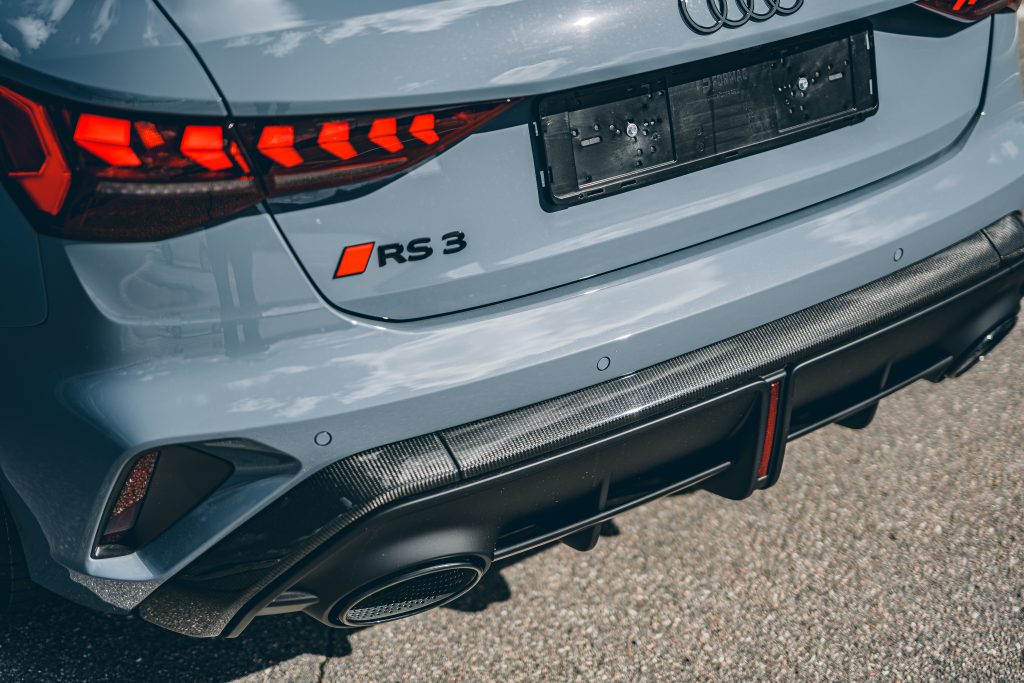
In photos, the RS3 can look like an A3 that’s done a few more pull-ups. In reality, the extra width in the arches, the squat stance, and the confident front end give it more presence than its size suggests. It’s a compact car that wears wide wheels like they’re mandatory, not optional.
Rental reality check: its length (4.38 m) is a gift in tight city parking, but the mirror-to-mirror width (just under 2.0 m) is what you’ll feel in older underground garages and narrow hotel ramps. Add low-profile tyres, and kerbs stop being “background scenery” and start becoming a negotiation. If you’re planning a photo-heavy trip—lakes, alpine roads, coastal towns—the RS3 has the stance to look like a hero without needing supercar-level space to exist.
Interior, seating, and UX
The RS3 cabin is a familiar Audi story: clean layout, solid materials, and a sense that most things were drawn with a ruler. That’s not praise-by-default—some rivals go louder and more “sporty”—but for a rental it’s a virtue. You don’t need a week to learn it, and it doesn’t punish you for wearing a normal jacket with normal pockets.
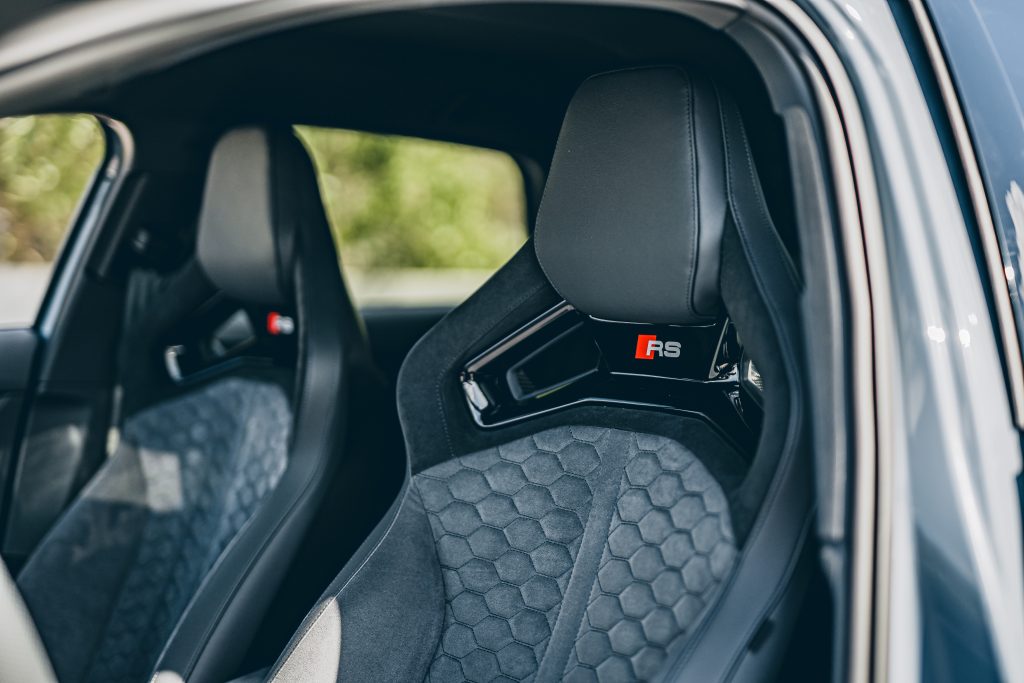
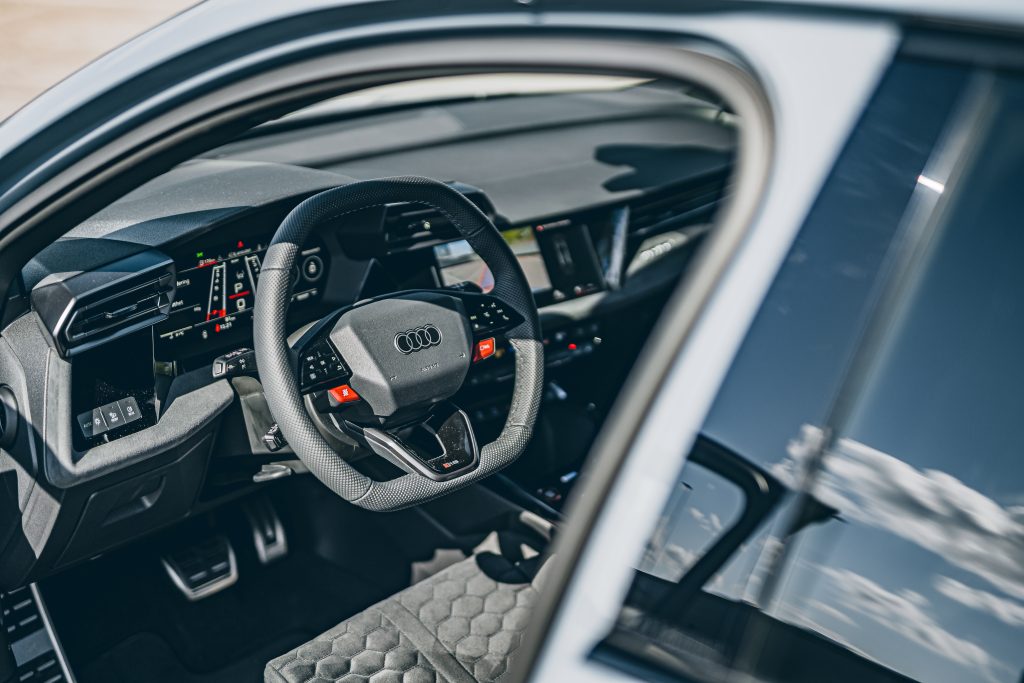
Seating position is appropriately low for a performance model, and the driving environment feels focused without feeling claustrophobic. The major day-to-day irritations aren’t dramatic; they’re the modern stuff. Glossy trim that looks smart until it collects fingerprints. Touchscreen logic that’s fine once memorised, mildly annoying when you’re trying to do three things at once at a traffic light. And, depending on trim/market, “helpful” driver aids that sometimes need a firm hand on the settings menu before they behave the way you want.
On the plus side, the performance interface is one of the RS3’s strong suits: configurable drive modes, a proper digital cockpit, and the sense that the car has a clear “two personalities” split—civilised when you want it, sharper when you ask. Independent reviews note that the facelift brought detail improvements rather than a whole new cabin, which is probably the right call: the fundamentals were already good.
Space and practicality
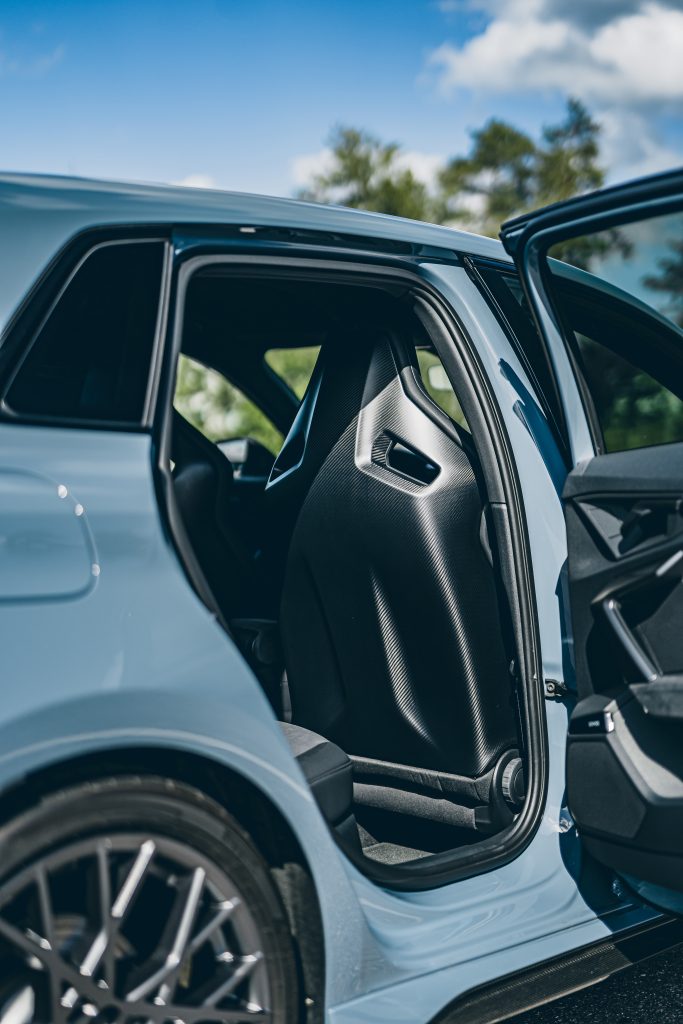
“Sportback” suggests everyday usefulness, and the RS3 mostly plays along—just with a few winks. Up front, space is straightforward for typical adult sizes, and the cabin feels airy enough for long stints. In the back, it’s workable for adults on a short-to-medium journey, but the combination of performance seats up front and a compact footprint means taller passengers will notice knee room and the general sense of being “in the back of a fast hatch,” not a limousine.
The boot is the bigger talking point: 282 litres with the rear seats up is not generous, and it’s the sort of number that makes hard-shell suitcases a strategic exercise. Fold the rear seats and you get a far more useful 1,104 litres, but for a rental you may not want to live in “two-seat mode” all week. Soft bags help. Packing cubes help more. If your trip is two people doing a stylish long weekend—perfect. If it’s four adults and airport luggage—plan carefully.
For road-trip comfort, the RS3’s compact dimensions are a benefit on twisty routes and in city centres, but the compromises are the usual performance-car ones: tyre roar can be more noticeable on coarse motorway surfaces, and the ride will depend heavily on wheel/tyre choice and damper settings. The car’s turning circle (12 m) is genuinely useful in tight places—hotel forecourts, ferry ramps, awkward multi-storey layouts—where “small fast car” beats “big fast car” every time.
How it goes: engine, gearbox, pace
The headline is simple: 294 kW, 500 Nm, 0–100 km/h in 3.8 seconds. The more interesting part is how it delivers that speed. The 2.5 TFSI five-cylinder isn’t just “power”; it’s texture. There’s a slightly off-beat rhythm to the way it builds revs, and—crucially—it doesn’t feel like it’s trying to impersonate a bigger engine. It has its own voice, and that matters when you’re renting something meant to feel special.
Independent reviews consistently highlight that Audi has kept the five-cylinder experience alive even as emissions and refinement demands tighten, and that the car’s upgrades have focused more on control and precision than chasing a bigger power figure. In practice, that means acceleration that feels immediate and repeatable, especially when grip is questionable—wet roundabouts, cold mornings, mountain roads that change texture every five kilometres.
The 7-speed S tronic is the right gearbox for this car’s mission: quick shifts when you’re pressing on, smooth enough when you’re not. The best compliment is that it mostly stays out of the way. Manual control is there when you want to manage gears yourself, but the RS3’s core appeal is that it can be devastatingly quick without demanding constant driver input.
Brakes are serious hardware (large discs, performance calibration), and they need to be, because the RS3 gets up to speed with barely any runway. The honest caveat for renters: big performance brakes and wide tyres tend to come with big replacement costs. You don’t need to fear them—just treat them like expensive shoes: they’re brilliant, but they don’t enjoy being abused.
Handling and comfort
The old Audi performance stereotype was “fast, secure, a touch nose-led when you really push.” The RS3’s torque splitter is Audi’s most direct answer to that, and reviewers note it meaningfully broadens the car’s dynamic range. By actively distributing torque across the rear axle, it helps the RS3 rotate more willingly and resist the plough-on feeling that can spoil front-engined AWD cars on tight, technical roads.
Does that make it a delicate, rear-drive scalpel? No—and it doesn’t need to be. The RS3 feels like a compact missile with real composure, not a car chasing purity points. On European road surfaces—cobbled city streets, scarred secondary roads, and smooth autoroutes—the comfort story will hinge on your tolerance for firmness. Independent tests frequently point out that the RS3 rides with purpose, and that the last degree of compliance is not its priority.
The upside is control. The chassis feels keyed-in, especially in the sharper drive modes, and the car’s compact dimensions make it easy to position on narrow mountain lanes where visibility and discipline matter more than outright power. This is where the RS3 shines as a rental: it’s exciting at realistic speeds, and you don’t need a racetrack to understand the point of it.
Fuel use and day-to-day running
Officially, the RS3 Sportback sits at 9.6–9.3 L/100 km combined (WLTP). That’s the “legal lab world,” and it’s a reasonable baseline for planning. In the real world, consumption will swing with traffic, temperature, and how often you dip into the car’s fun side—particularly on mountain routes where you’ll be on and off the throttle.
For renters, the practical point is simple: expect more fuel stops than you would in a regular A3, and plan accordingly if your itinerary includes remote scenic roads. The RS3’s fuel tank is 55 litres. Also worth noting: Audi specifies 98 RON petrol in the German technical data sheet, which is widely available across Europe but still something you should choose deliberately at the pump rather than reflexively.
Servicing is not your concern on a short rental, but it’s a good indicator of how “serious” the car is: the German sheet lists up to 30,000 km / 2 years service interval (whichever comes first), varying by usage and market. Translation: it’s engineered like a modern performance Audi—robust, complex, and best treated with respect rather than bravado.
Safety, driver assistance, and reliability notes
Euro NCAP awarded the Audi A3 (the RS3’s close platform sibling) a five-star rating, with strong occupant protection scores and modern safety systems assessed in the test protocol. As always, note the nuance: ratings apply to the tested configuration and safety equipment availability can vary by year and market.
Assistance tech in this class typically includes AEB, lane support, adaptive cruise functions, parking aids and camera systems, depending on trim and country. An Audi RS3 specification guide also lists features like Audi pre sense front, adaptive cruise assist, side assist, and 360-degree cameras (market-specific). For a European rental, that mix matters because the RS3’s width-with-mirrors and low-profile tyres make parking assistance genuinely useful rather than just a box-ticking feature.
On reliability, the responsible stance is boring but true: a high-output turbo engine, dual-clutch transmission, and torque-vectoring AWD hardware are inherently more complex than a base model. That doesn’t mean “unreliable”; it means maintenance quality matters over the long term. As a renter, your job is simpler—warm it up sensibly, don’t bounce it off cold revs, and treat kerbs and potholes like they’re trying to steal your deposit.
Should you rent an Audi RS3 Sportback in Europe?
If you’re using Rentolux to add one memorable car to a trip, the RS3 is a smart kind of extravagant. It’s not “look at me” in the way a supercar is, yet it still feels like an event every time you start it. And because it’s compact, you can actually use it—tight hotel car parks, city centres, ferry queues—without the constant low-speed anxiety that comes with larger performance cars.
Three rental scenarios where it makes sense
- Weekend drive: Base yourself somewhere scenic—lakes, coastal roads, foothills—and let the RS3 do what it’s good at: fast transitions, strong grip, and that five-cylinder soundtrack on the way out of town. Choose routes with variety, not just speed.
- Business travel: It has the right badge and the right cabin for meetings, and it’s discreet enough to arrive without theatrics—until you choose otherwise on the way back to the hotel.
- Event / photo day: The stance works on camera, the Sportback shape is practical, and it feels modern and purposeful in the background of real locations—old towns, mountain hotels, coastal promenades.
Practical renter tips (that actually matter)
- Parking: Remember the mirror width; fold mirrors in tight garages and use camera/parking aids when available.
- Kerbs and ramps: Low-profile tyres don’t forgive. Approach steep ramps slowly and square-on where possible.
- Drive modes: Use the calmer setting in cities (you’ll look smoother and feel less jitter), then switch to the sharper modes when the road earns it.
- Fuel: Plan for premium petrol (98 RON per Audi’s German data) and more frequent fill-ups if you’re doing mountain routes.
- Luggage: If you’re travelling as a pair, bring soft bags. The boot is 282 litres seats-up—usable, but not generous.
Bottom line: if your trip includes both city life and proper driving roads, the RS3 is one of the few cars that doesn’t force you to choose. Availability and pricing will vary by city and season—check dates, confirm luggage needs, and book accordingly.
Alternatives to consider
- Cheaper: VW Golf R — Similar compact “do-everything” brief with AWD traction and serious pace, generally less exotic in engine character and cabin theatre than the RS3, but often easier on the conscience. (Ideal if you want speed without the RS-level running-cost vibe.)
- More driver-focused: BMW M2 — Different shape and mission: rear-drive balance, stronger emphasis on steering/rotation, and a more old-school performance feel. Less subtle, less practical, but more “driver’s car” in the traditional sense.
- Comfort/status: Audi RS4 Avant (or S/RS larger Audi estate options, where available) — If your trip is more autobahn miles and luggage than tight passes, a larger performance estate brings extra refinement and real space, with the same premium ecosystem. You lose some of the RS3’s point-and-squirt playfulness, but you gain effortless long-distance ease.
Conclusion
The Audi RS3 Sportback is a rare modern performance car that feels both usable and genuinely characterful. The numbers are strong, the tech is clever, and the five-cylinder gives it a heartbeat most rivals can’t imitate. The trade-offs are predictable—ride firmness, boot space, and running costs—but they’re the kind you can accept for a short, carefully chosen rental. If your European trip needs one car that can do the city politely and the mountains properly, the RS3 is an unusually convincing answer.